1 oz 2026 Canada's National Parks: Grasslands National Park Colourized Proof Silver Coin | Royal Canadian Mint


Related products
Take in the view of the Canadian prairie in Grasslands National Park.
Windswept plains, weathered buttes, rolling uplands and river valleys—welcome to Grasslands National Park, one of the few remaining natural grasslands in North America. Coin #3 travels to this national park and Dark Sky Preserve in southwestern Saskatchewan, where blue sky meets Canadian prairie, and where visitors can experience the wonders of the preserved mixed-grass prairie ecosystem. Home to rare species and spaces, rich history and wondrous wildlife, its rugged land formations offer a window into prehistoric times, while the thousands of tipi rings are remnants of a past inextricably linked to the bison.
Coin #3: Travel to where the bison roam.
COIN HIGHLIGHTS
- See Canada in all its beauty and splendour. An annual series, Canada’s National Parks invites you to (re-)discover the sights, species and stories that make each region of Canada so unique. Canada’s National Parks—in the hearts and minds of Canadians, and in the eyes of the world!
- Different theme for 2026. Moving on from 2024’s Wondrous Waters, the theme for 2026 is Canada’s National Parks. It’s another fun cross-country journey, as each of the four coins presents a view from one of Canada’s many national parks and park reserves.
- Take a seat, take in the view. The two red chairs on your coin’s reverse, and on all Canada’s National Parks coins, invite you to sit back, connect with nature and enjoy the view! These are based on the red chairs found in over 100 locations administered by Parks Canada, the agency that manages Canada’s national parks, historic sites and marine conservation areas.
- Classic Canadiana. A fun series for all ages, this coin-by-coin trip across Canada represents more than an armchair travel experience—it’s a year-long adventure in collecting.
- Includes serialized certificate. The Royal Canadian Mint certifies all of its collector coins.
- No GST/HST.
PACKAGING
Your coin is encapsulated and presented in a black Royal Canadian Mint-branded clamshell with a black beauty box.
DID YOU KNOW?
Approximately 10,000 years ago, upon the retreat of the glaciers the prairies became home to several Indigenous groups: The A’aninin (Gros Ventres), Nakoda (Assiniboine), Nêhiyawak (Plains Cree), Niitsitapi (Blackfoot), Dakota and Lakota (Sioux)—each nation linking their lives to the migrations of the bison. Today, the evidence is profound with bison drive lanes, projectile points, tipi rings and other cultural features that dot the park landscape. Grasslands National Park is home to one of the largest concentrations of undisturbed cultural resources in Canada.
The park was established in 1981 to protect and present a representative example of the Prairie Grasslands Natural Region using a unique willing-buyer, willing-seller model. The park currently consists of 730 km2 and could eventually cover 906 km2 when land acquisition is complete. Grasslands National Park is comprised of two blocks: the West Block, which centres on the Frenchman River Valley; and the East Block which highlights the Rock Creek Badlands. The revealing landscape of the Badlands led to the first recorded find of dinosaur remains in Canada in 1874. The East Block is also one of the best places in the world for viewing the Cretaceous-Paleogene (KPG) Boundary—a layer of sediment corresponding to the mass extinction event that marked the end of the age of dinosaurs.
After a 120-year absence, the bison that once roamed the prairies in great numbers was reintroduced to Grasslands National Park in 2005. The initial herd consisted of 71 bison that originated from Elk Island National Park in Alberta; today, the herd includes over 400 individuals that freely roam in 180 km2. The West Block is also the only place in Canada where the playful black-tailed prairie dog is found in its natural habitat.
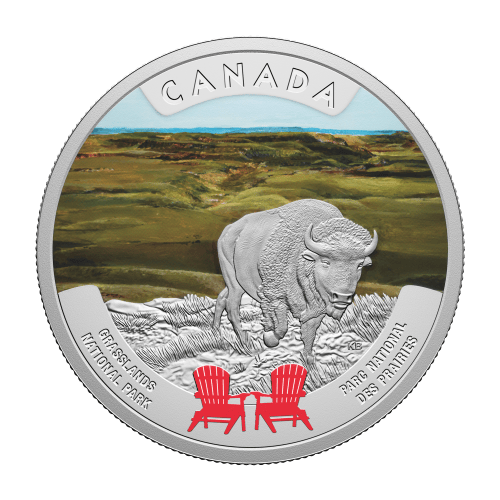
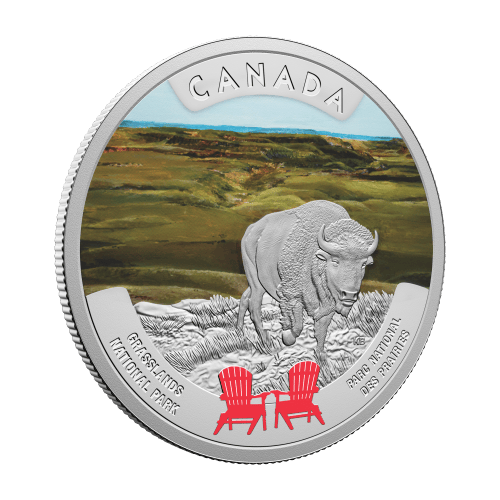
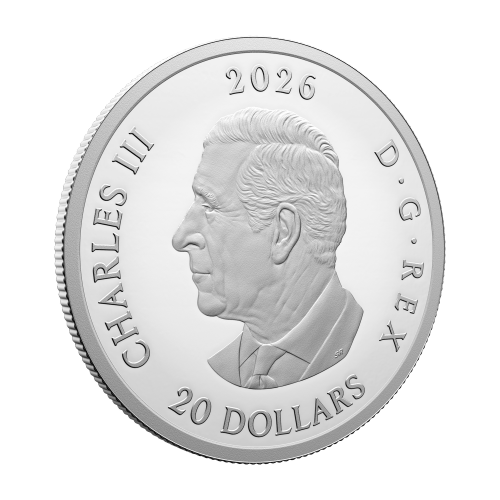
Designed by Canadian artist Kerri Burnett, your coin’s reverse invites you to take a seat and enjoy the view from Grasslands National Park, located in southwestern Saskatchewan. A mighty plains bison (Bison bison bison) appears in the engraved foreground, while behind it, selective colour captures the serene beauty of the open prairie landscape, as it extends into the horizon under a clear blue sky. Selective colour also highlights two red Adirondack chairs—a familiar sight in Canada’s national parks. The obverse features the effigy of His Majesty King Charles III by Canadian artist Steven Rosati.
ABOUT THE ROYAL CANADIAN MINT
The Royal Canadian Mint is known as one of the most reputable mints in the world. The Ottawa Branch of the Royal Mint opened in 1908 and was renamed The Royal Canadian Mint in 1931 when control was transferred to the Canadian government. Their high standards for excellence and quality allowed them to be the first refinery to manufacture 9999 fine gold bullion coins in 1982, as well as the first to reach 99999 fine gold purity in 1998.