2026 Allegories of Peace and Freedom Antiqued Silver Coin | Royal Canadian Mint
Related products
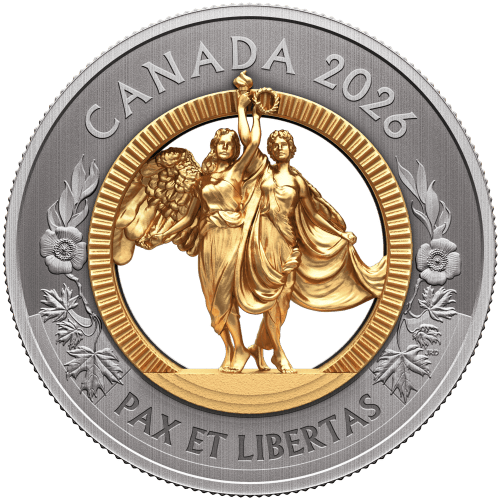
Peace and Freedom—PAX ET LIBERTAS—side by side in cast form.
Peace and freedom each stand as noble ideals, but their true strength is revealed in how inseparably they uphold one another.
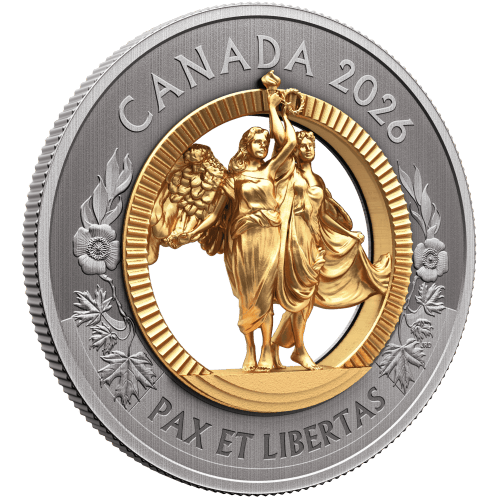
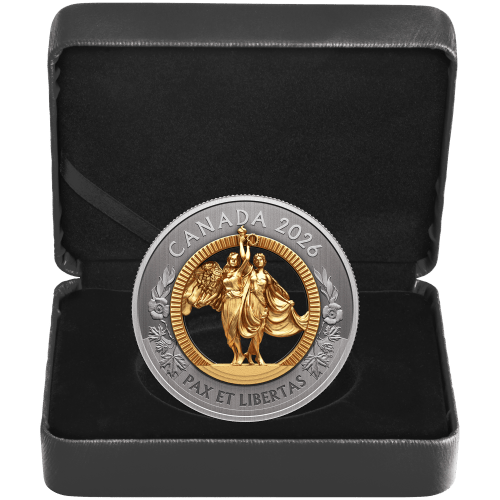
Inspired by the allegories atop Canada’s National War Memorial, Royal Canadian Mint's fourth dual-sided, multidimensional coin reimagines their forms with fresh intricacy, presenting “PAX” and “LIBERTAS” together for the first time in this series. Cast in 99.99% pure silver and plated with yellow gold, the allegorical figures are set in an antiqued 99.99% pure silver rim accented with poppies, laurel and maple leaves that reflect the spirit, elegance, and meaning of the originals—a fitting tribute on the 100ᵗʰ anniversary of the winning design’s selection for the commemorative monument.
Honouring ideals through art and allegories.
COIN HIGHLIGHTS
- RCM's fourth Multidimensional Allegory coin. This multidimensional fine silver coin is a cast interpretation that honours the allegorical spirit of Canada’s National War Memorial, bringing peace and freedom together in a refined, symbolic form.
- Symbolic flourishes. Echoing the National War Memorial in spirit, the boughs and stone motif reflect the enduring ideals of peace and freedom for which so many gave their lives.
- A notable anniversary. This coin tribute to “PAX ET LIBERTAS” (“Peace and Freedom”) arrives a century (1926) after the model submitted by British sculptor Vernon March was selected as the winning design concept for Canada’s National War Memorial.
- Grow your collection of allegories. Available in this fine silver multidimensional format and (new for 2026) as a fully engraved work of art in 1 oz. of 99.99% pure gold, Allegories of Peace and Freedom joins a growing line-up of Canadian allegorical-themed coins—collect them all!
- Low mintage. Only 1,700 coins are available worldwide—less than in 2025, and previous Multidimensional Allegory coins all sold out.
- Includes serialized certificate. The Royal Canadian Mint certifies all of its collector coins.
- Weight: 104.63 g (99.99% pure silver outer ring); 37.68 g (99.99% pure silver cast)
- No GST/HST.
PACKAGING
Your coin is encapsulated and presented in a black Royal Canadian Mint-branded clamshell with a black beauty box.
A DUAL SIDED DESIGN
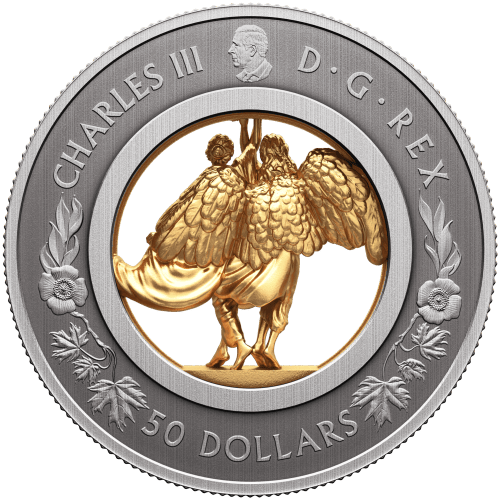
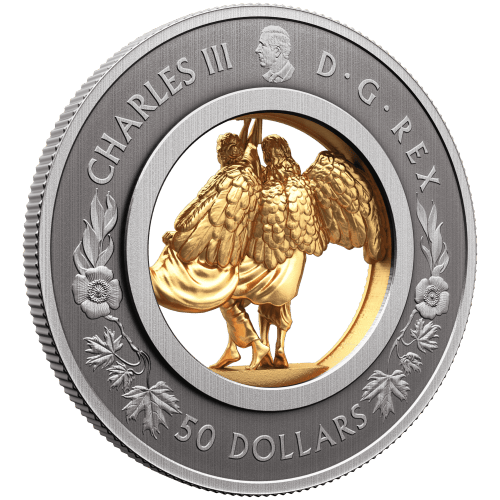
Crafted entirely in 99.99% pure silver, the coin’s open core houses the highly intricate, gold-plated allegorical figures that have been cast in 99.99% pure silver. The obverse is a continuation of the reverse design, providing a 360-degree view of the allegories.
GOLD PLATING
The silver cast figures are plated with yellow gold, which contrasts beautifully with the coin’s antique finish.
DID YOU KNOW?
British sculptor Vernon March was among the seven finalists invited in 1925 to submit scale models for an international competition to design Canada’s National War Memorial. His proposal was selected in January 1926, but after his sudden death from pneumonia in 1930, six of his siblings stepped in to complete the bronze statues, including the figures of Peace and Freedom. The commemorative monument was finished in 1938 and unveiled the following year.
Inspired by the allegorical figures atop Canada’s National War Memorial, the double-sided design by Royal Canadian Mint 3D artist-engraver Julien R. Duguay features an open core that houses the gold-plated allegorical figures of Peace and Freedom (“PAX ET LIBERTAS”) cast in 99.99% pure silver—Peace holds a laurel wreath high, while Freedom holds up a torch to light the way forward. The outer ring’s stone motif, as well as the delicate boughs featuring a Poppy with laurel and maple leaves, deepen the tribute and echo the spirit of the commemorative monument. The obverse features the effigy of His Majesty King Charles III by Canadian artist Steven Rosati.
ABOUT THE ROYAL CANADIAN MINT
The Royal Canadian Mint is known as one of the most reputable mints in the world. The Ottawa Branch of the Royal Mint opened in 1908 and was renamed The Royal Canadian Mint in 1931 when control was transferred to the Canadian government. Their high standards for excellence and quality allowed them to be the first refinery to manufacture 9999 fine gold bullion coins in 1982, as well as the first to reach 99999 fine gold purity in 1998.